The microwave sky as seen by PlanckMottled structure of the CMB, the oldest light in the universe, is displayed in the high-latitude regions of the map. The central band is the plane of our galaxy, the Milky Way. (Courtesy of European Space Agency)
 Eric Linder is a theoretical physicist with Berkeley Lab’s Physics Division and member of the Supernova Cosmology Project. (Photo by Roy Kaltschmidt) Mystery fans know that the best way to solve a mystery is to revisit the scene where it began and look for clues. To understand the mysteries of our universe, scientists are trying to go back as far they can to the Big Bang. A new analysis of cosmic microwave background (CMB) radiation data by researchers with the Lawrence Berkeley National Laboratory (Berkeley Lab) has taken the furthest look back through time yet – 100 years to 300,000 years after the Big Bang – and provided tantalizing new hints of clues as to what might have happened.“We found that the standard picture of an early universe, in which radiation domination was followed by matter domination, holds to the level we can test it with the new data, but there are hints that radiation didn’t give way to matter exactly as expected,” says Eric Linder, a theoretical physicist with Berkeley Lab’s Physics Division and member of the Supernova Cosmology Project. “There appears to be an excess dash of radiation that is not due to CMB photons.”Our knowledge of the Big Bang and the early formation of the universe stems almost entirely from measurements of the CMB, primordial photons set free when the universe cooled enough for particles of radiation and particles of matter to separate. These measurements reveal the CMB’s influence on the growth and development of the large-scale structure we see in the universe today.Linder, working with Alireza Hojjati and Johan Samsing, who were then visiting scientists at Berkeley Lab, analyzed the latest satellite data from the European Space Agency’s Planck mission and NASA’s Wilkinson Microwave Anisotropy Probe (WMAP), which pushed CMB measurements to higher resolution, lower noise, and more sky coverage than ever before.“With the Planck and WMAP data we’re really pushing back the frontier and looking further back in the history of the universe, to regions of high energy physics we previously could not access,” Linder says. “While our analysis shows the CMB photon relic afterglow of the Big Bang being followed mainly by dark matter as expected, there was also a deviation from the standard that hints at relativistic particles beyond CMB light.”Linder says the prime suspects behind these relativistic particles are “wild” versions of neutrinos, the phantomlike subatomic particles that are the second most populous residents (after photons) of today’s universe. The term “wild” is used to distinguish these primordial neutrinos from those expected within particle physics and being observed today. Another suspect is dark energy, the anti-gravitational force that accelerates our universe’s expansion. Again, however, this would be from the dark energy we observe today.“Early dark energy is a class of explanations for the origin of cosmic acceleration that arises in some high energy physics models,” Linder says. “While conventional dark energy, such as the cosmological constant, are diluted to one part in a billion of total energy density around the time of the CMB’s last scattering, early dark energy theories can have 1-to-10 million times more energy density.”Linder says early dark energy could have been the driver that seven billion years later caused the present cosmic acceleration. Its actual discovery would not only provide new insight into the origin of cosmic acceleration, but perhaps also provide new evidence for string theory and other concepts in high energy physics.“New experiments for measuring CMB polarization that are already underway, such as the POLARBEAR and SPTpol telescopes, will enable us to further explore primeval physics, Linder says.Linder, Hojjati and Samsing are the authors of a paper describing these results in the journal Physical Review Letters titled “New Constraints on the Early Expansion History of the Universe.” Hojjati is now with the Institute for the Early Universe in South Korea, and Samsing is with the DARK Cosmology Centre in Denmark.This research was primarily supported by the DOE Office of Science.For more about the Supernova Cosmology Project go hereSource: Lawrence Berkeley National Laboratory
 Source:
First Hundred Thousand Years of Our Universe Images
... Archaeology News Network: First hundred thousand years of our universe
(400 x 225 - 40.56 KB - jpeg)
Astronomy Cmarchesin: First Hundred Thousand Years of Our Universe
(246 x 320 - 24.39 KB - jpeg)
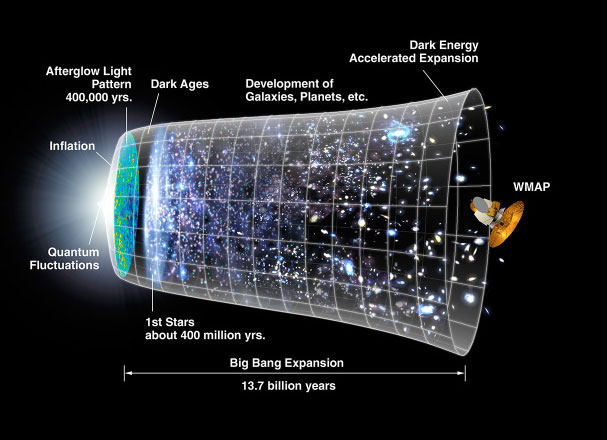
timeline of the universe the expansion of the universe over most of ...
(607 x 440 - 57.52 KB - jpeg)

developed over time from its initial seed in the Big Bang. That story ...
(768 x 710 - 97.64 KB - jpeg)

 I recently finished the Netflix original series House of Cards. I've watched full series on Netflix before but this was my first foray in to original content on a platform like this. The pros of this kind of programming roll out are obvious.Even though the full season was released on February 1st, I didn't start watching it until early April. Normally, if I plan on watching a television series, I'll be there from the beginning. Not necessarily because I'm really looking forward to it, but I don't like to have anything spoiled for me. My daily magazine and Internet reading material has the potential to spoil things for me if I fall too far behind. Or if it becomes a buzz worthy show, my friends might accidentally clue me in on something I may not know. I guess I have an unnatural desire to be caught up. But this is where the biggest con comes in. I did watch the season yet I feel like if I did want to talk about it, I'm on an island. Even the one person who I thought would watch it if it was on regular television doesn't have Netflix and has no urgency to subscribe. He figured he'll just "Free Trial" it when Arrested Development Season 4 gets released and plow through them both then. (Without being spoilery) Luckily, House of Cards isn't a water cooler show. It was entertaining but there isn't really a lot I would want to text a friend about after watching a new episode. It actually felt like I was watching a show that aired on basic cable last year and I was just catching up.With Arrested Development on the other hand, I'm actually worried about how that whole viewing experience is going to go. That was a show me and my friends would talk about and quote for the whole week before the next one aired. What if everyone I know doesn't devour at least half the season on May 26th? How will I know which quotes and can throw in to conversations and when it's okay to do it so? First world problems I guess.